
Federal BOP Releases and Clinton County
The Federal Bureau of Prisons manages federal sentenced custody. A person from Clinton County may serve a federal sentence at an institution elsewhere, but the research found no BOP prison in Clinton County. Federal pretrial detention follows a different path, usually involving the U.S. Marshals Service, a federal court, and a contract holding facility. BOP becomes the central public locator after federal sentencing and designation.
Departure from BOP may mean sentence completion, another form of federal community placement, or transfer to a different sovereign. A result that says released or not in BOP custody confirms the BOP side of the record. It does not rule out a Kentucky warrant, local hold, USMS action, or ICE detention. State the result as release from BOP custody until the destination is known.
| Last known status | Correct first source |
|---|---|
| Federal sentenced inmate | BOP Inmate Locator and federal docket |
| Federal pretrial detainee | Federal docket, USMS, and last holding facility |
| Ordinary Clinton County jail stay | Clinton County Jail, court file, and Kentucky VINE |
| Civil immigration detention | ICE locator, ERO, and immigration records |
Confirm a Federal BOP Release
The official BOP Inmate Locator is the main public route. BOP explains that its electronic coverage extends from 1982 to the present. Search by federal identifier when one is known. A number search reduces confusion between people who share a name.
- Choose the number search and enter a BOP register number, DCDC number, FBI number, or INS number when available.
- If no number is known, use the name search with first and last name, then add race, sex, and age as needed.
- Compare the result carefully with the federal case. Names and ages can overlap.
- Read the location or release wording and date exactly. Do not translate “not in BOP custody” into release from every agency.
- Open the federal docket to compare the judgment, sentence, later orders, and supervision information.
- When the destination or exact basis remains unclear, seek the relevant BOP or federal court record.
The general Clinton County released-person search route helps classify whether the last custody was county, Kentucky state, federal sentenced, federal pretrial, or immigration custody.
Federal BOP Locator Record Coverage
The official BOP page explains the scope of locator records and why some information may require a different archive. Review the BOP locator records explanation before treating a no-result as a conclusion.
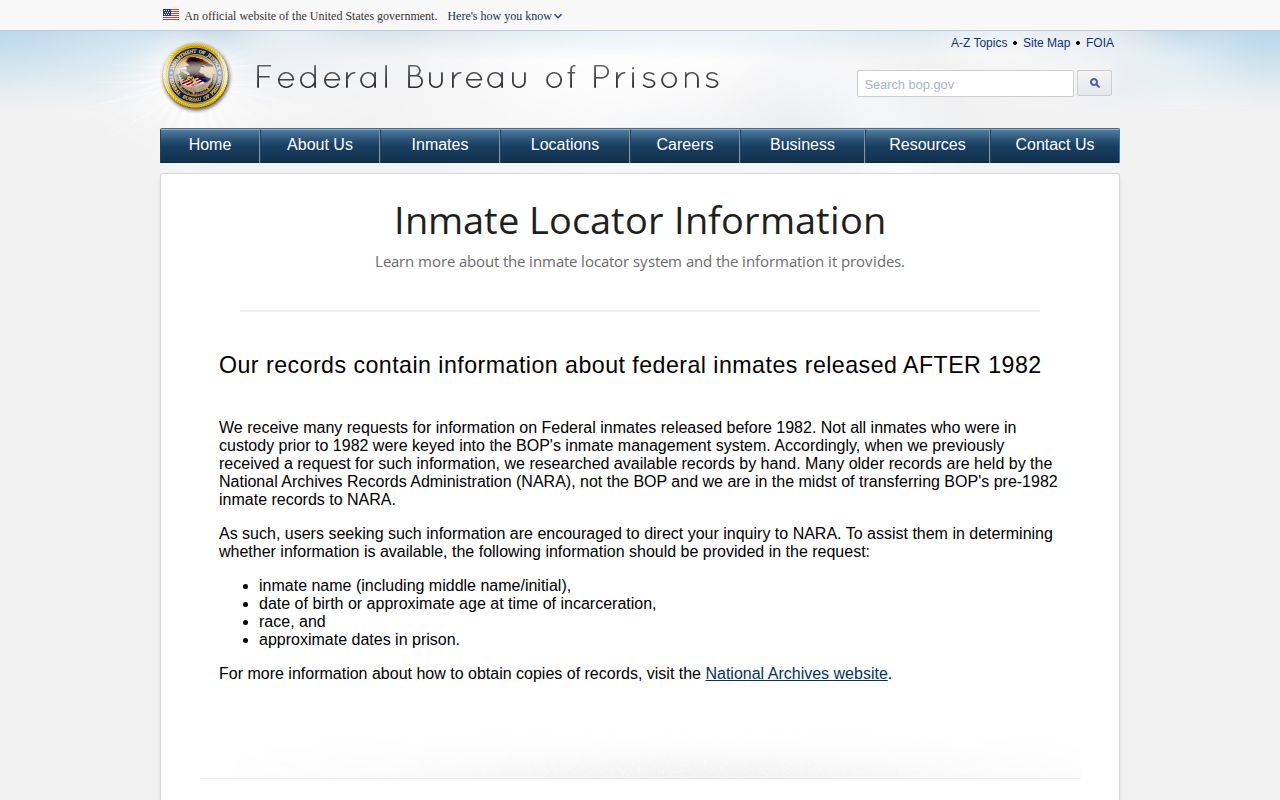
The record-coverage screen helps place the public lookup in time. BOP's locator covers federal inmates from 1982 forward. Older federal custody can require archival research. A spelling issue, identifier mismatch, pretrial status, or custody held by another sovereign can also explain why a person is absent.
A former inmate's entry may show a release date and wording such as released or not in BOP custody, depending on the record. That date should be compared with the federal docket. The docket can show the sentence and later court action, while the locator shows the public BOP custody result.
Federal BOP Release Record Fields
The federal locator has a narrower purpose than a full case file. It helps match the person and identify current or former BOP status. The federal docket and agency records add the legal and correctional context. Do not infer a release type that the public result does not state.
| Record item | What it contributes |
|---|---|
| BOP register or other federal number | Matches the federal correctional identity |
| Name and demographic filters | Narrow a result when no number is available |
| Facility or custody wording | Shows the BOP status represented by the locator |
| Release date | Shows the date recorded in the BOP public result |
| Federal judgment and sentence | Explains the court-imposed term |
| Later docket order | May document release, modification, or another court action |
| Transfer or detainer record | May identify continued custody under another authority |
A BOP release date is not a Kentucky DOC discharge date or a Clinton County jail timestamp. Each system owns its own event. The same person can have sequential records in more than one system.
Federal Pretrial Custody Is Different
The U.S. Marshals Service manages federal pretrial custody, transportation, and detention arrangements. It often uses contract facilities. USMS does not offer a broad public historical released-person locator comparable to BOP. A pretrial detainee may therefore be absent from the BOP sentenced-inmate path even while held under federal authority.
Use the federal docket for the release, bond, detention, or dismissal order. Then contact the last holding facility or responsible federal office as appropriate for the physical custody event. After sentencing and BOP designation, the BOP locator becomes more useful. The sequence can be federal arrest, USMS detention, sentencing, BOP designation, BOP custody, then release or another transfer.
Do not treat a move from a contract jail to a BOP institution as release. It is a transfer within the federal custody chain. Likewise, release on a federal court order may still be followed by a state or immigration hold.
Note: The federal docket explains court authority, while the holding facility or agency record is the better source for the actual departure time.
Federal BOP Detainers and Transfers
A detainer is a request or authority that can cause custody to continue after one agency ends its hold. This is the chief risk in reading a federal release result too broadly. BOP can correctly show that a person is no longer in its custody while Kentucky, a local agency, USMS, or ICE holds the person next.
Check the docket for references to another case or authority. If immigration custody is plausible, use the ICE Online Detainee Locator and ERO follow-up. The ICE locator is chiefly a current-location tool, so a no-match does not prove historical release. If a Kentucky sentence is plausible, use KOOL. For a local Clinton County hold, contact the jail and read the Clinton County case.
- BOP release
- The end of the person's BOP custody as recorded by the federal prison system.
- Transfer
- Movement to another institution or authority while custody continues.
- Detainer
- Another authority's claim that may prevent community freedom after BOP release.
- Supervised release
- A federal court-ordered period in the community after imprisonment, distinct from Kentucky parole.
Federal BOP Records and Contact
The public locator is the first contact route because no specific federal institution in Clinton County exists to call. Once the result identifies an institution or former status, use the official BOP site and federal docket to route the records question. Ask for a defined existing record, such as a release date record, transfer record, or other document tied to the federal register number.
Federal Bureau of Prisons
Public search: BOP Inmate Locator
Coverage details: About locator records
Facility: No BOP prison was found in Clinton County
Case source: Federal court docket for judgment and release orders
Do not send a county jail request to BOP for an ordinary Albany arrest. Clinton County Jail controls its own booking and release records. Kentucky DOC controls its state correctional records. BOP controls records within federal sentenced custody. Identifying the sovereign first prevents a request from being routed to an office that never held the person.
For older custody before the locator's electronic range, archival sources may be required. Keep the name, date of birth, federal number, sentencing court, approximate custody dates, and known institution ready. Those facts allow the proper federal office or archive to identify the record.
About Federal BOP Institutions
Federal BOP institutions form a national system for sentenced federal custody. They are not county jails and do not publish Clinton County's local release list. No federal prison, USMS-operated facility, or ICE contract detention site was found within Clinton County in the official sources reviewed. A person with local ties may still be held elsewhere after federal proceedings.
Facility designation can change during a sentence. A current institution in the locator indicates federal prison custody. Community placement or a release date must be read using the wording BOP supplies. The federal judgment, Bureau record, and any later transfer record form the evidence chain for a released federal inmate.
A Clinton County arrest story or local jail entry cannot prove later federal release. It may establish only that the person was lodged locally on a stated date. Follow the custody chain through the federal docket, USMS when pretrial, and BOP after designation.
Verify Federal BOP Release Scope
Before closing the search, state exactly what has been confirmed. “Released from BOP custody on the date shown” is precise. “Released from all custody” requires checking any known state, local, USMS, or immigration hold. A person can leave BOP for the community, another authority, or a form of supervised federal status.
Use at least two matching records when the result matters. The locator and federal docket are the usual pair. Add the receiving agency record when there is a transfer. Match the federal number, name, date, court, and custody wording, then preserve the source date because public systems can update.
Public Record Search
Sponsored Results